
AURA INVALIDES reveals the true spirit of an iconic monument in the Paris skyline: the Dôme des Invalides. A masterpiece of classical architecture, the Dome has witnessed more than three centuries of French history.
The narrative of the experience is directly inspired by the events that have shaped the monument's history, from its construction to the present day.
Discover the numerous references that informed the creation of the AURA Invalides show, designed with the help of the Musée de l'Armée's curators.
MOVEMENT I - Construction
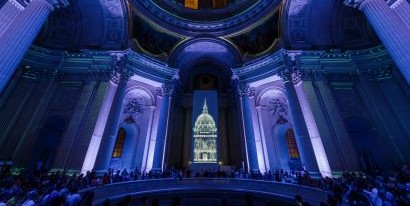
In 1676, Jules Hardouin-Mansart was still a relatively new architect when he was asked to design a monumental church at Les Invalides for Louis XIV. He extended the nave, now known as the "soldiers' church", into an impressive royal chapel, the "Dome church". He created a masterpiece of harmony and perspective, with clean lines and perfect proportions.
The Dome features a skylight surmounted by a fleur-de-lys spire topped by a cross. The whole structure soars skywards to a height of over 101 m.
The royal church remained the tallest monument in Paris until the construction of the Eiffel Tower. The interior layout was significantly altered between 1842 and 1853 by the excavation work and the erection of the baldachin altar for Napoleon's tomb.
The intention of Movement I is to gradually introduce visitors to the spaces and allow them to connect with the Dome on a personal level. Using a restrained and minimalist visual and musical aesthetic, the various paintings emphasise the lines of the architecture and recall the plans of Jules Hardouin-Mansart.
MOVEMENT II - Memory
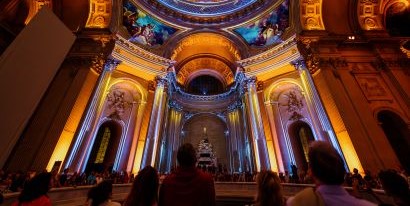
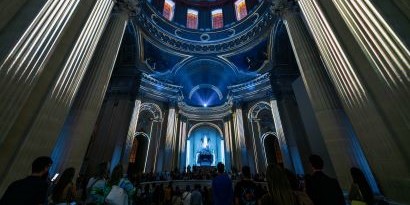
Movement II invites visitors to discover fragments of Les Invalides' past. It explains the change in the site's function from a church to a military pantheon, highlighting the tombs of a number of illustrious figures from French history: Turenne, Vauban, Jérôme and Joseph Bonaparte, Foch and Lyautey, not to mention the commanding presence of the Emperor's tomb in the centre of the Dome.
You can find more details about the chapel scenes at the bottom of the page in the "EXPERIENCE – The chapels" section.
Fragments of memory scene
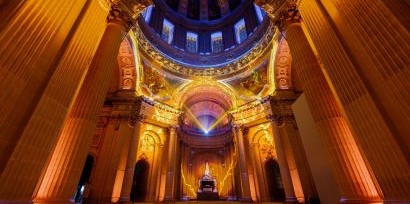
The particles represent fragments of memory gathering at the centre of the Dome.
This scene depicts the convergence of the individual memories held in the different chapels into a collective memory.
Battle scene
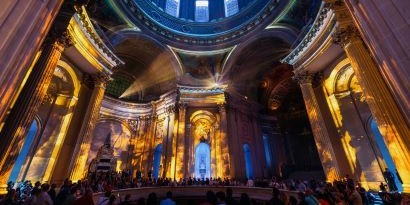
This painting evokes the tormented and complex period of the 19th century, a time of revolutions and profound transformations of peoples and regimes.
The scene is based on Napoleonic-era lead soldiers from the Musée de l'Armée's collections. They were selected on site and 3D scanned for the purposes of this scene.
Return of the Ashes scene
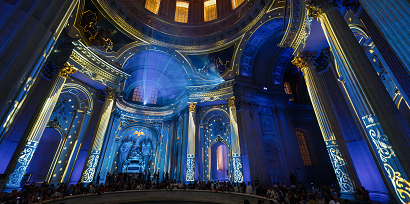
This scene is a reinterpretation of the Return of the Ashes described by Victor Hugo in his "Things Seen" collection published in 1846.
This painting marks the transformation of the Dôme des Invalides to accommodate the Emperor and its transition from a royal to an imperial function.
The scene is set to an extract from Berlioz's Requiem, composed in 1837 and performed for the first time at the Dôme des Invalides.
Scene set to Ravel's music
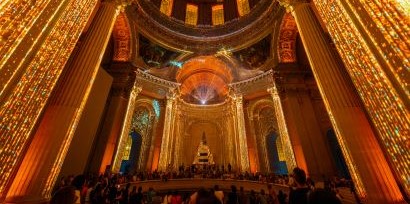
Light and particles of memory come alive to the sound of a piece by Maurice Ravel entitled "Une barque sur l'océan" (A Boat on the Ocean).
This synaesthetic and abstract painting evokes the artistic and musical memory of Les Invalides and the artistic innovation that characterised the 19th century.
Paris scene 1889 (Eiffel Tower)
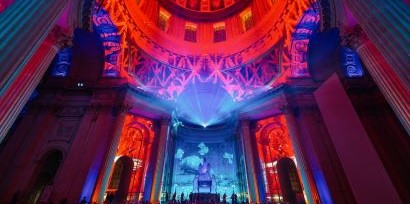
This scene depicts the influence of the Dôme des Invalides beyond its walls. By positioning the Hôtel National des Invalides at the gateway to Paris, Louis XIV laid out the main lines of the city as it became more modern and open. At the end of the 19th century, the Universal Exhibitions of 1889 and 1900 were held around Les Invalides, cementing its role in an innovative and progressive Paris.
In 1889, the Eiffel Tower replaced the Dôme des Invalides as the tallest monument in Paris. That same year, artist Georges Garen produced the engraving "Embrasement de la Tour Eiffel" (The Eiffel Tower Ablaze) in shades of midnight blue and flaming red.
This piece was the main source of inspiration for this scene, which symbolises the close relationship between the two monuments. Claude Debussy's "Clair de Lune" accompanies this scene.
MOVEMENT III - Elevation
Movement III offers visitors a chance to let go emotionally, after exploring the architecture and discovering the rich history of Les Invalides.
Visitors can experience an immersive connection with the site, allowing them to feel its grandeur and beauty in a spectacular finale.
Soprano scene
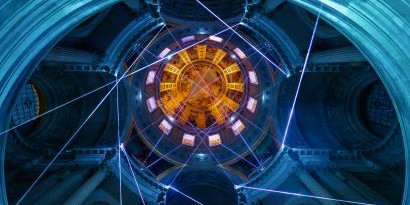
A visceral connection is forged between the beams of light and the soprano's compelling voice.
The notes echoing through the space tie the various architectural elements together and fill the centre of the Dome.
Perspectives scene
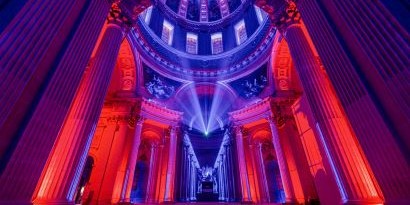
This painting creates extrusions into the existing architecture.
It opens up and increases the space to challenge the spectators' perceptions.
This scene is also a reminder that Jules Hardouin-Mansart's original design included two large windows in place of the tombs of Vauban and Turenne. They were walled up on the inside when the Dome was converted into a military pantheon, and no longer serve their purpose of providing an opening and extra light. They are still visible on the outside.
Pigment scene
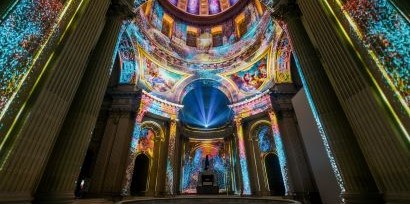
DIn this scene, fragments of painting escape from the medallions representing the 4 evangelists and gradually take over the entire Dome.
These paintings, commissioned by Jules Hardouin-Mansart from Charles de la Fosse, are known for their remarkable use of colour, which was very innovative for the time. Charles de la Fosse is considered by many to be the most important French painter of the 1700s.
The scene is a colourful and vibrant tribute to the artist's triumphant creations.
Phantasmagoria scene
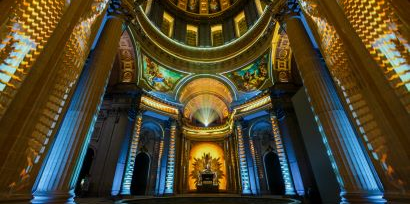
This painting is a phantasmagorical vision of an articulated monument, which comes to life like a clockwork toy.
Creating the illusion of a gigantic kaleidoscope, this scene accentuates the proportions and perfect harmony of the Dome.
Final scene
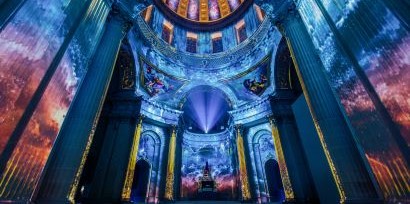
The final scene depicts clouds, inspired by the sky painted by Charles de la Fosse for the Dome.
The clouds spread across the entire monument to create a spectacular rising movement that brings the experience to a climactic conclusion.
EXPLORATION - Chapels
The Chapelle of Saint-Jérôme Napoleon Bonaparte’s temporary mortuary
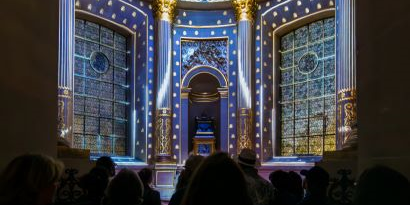
Napoleon Bonaparte’s remains were transferred from the island of Saint Helena to Les Invalides on December 15, 1840, and temporarily laid to rest in this chapel until April 2, 1861. Crowds gathered here to pay their respects to the Emperor, while builders sculpted a future imperial tomb within the Dome Church. This scene illustrates the chapel’s interior.
Today, the chapel serves as the final resting place for Jérôme Bonaparte, Napoleon’s youngest brother and the former King of Westphalia, from 1807 to 1813. In late 1848, Jérôme was appointed the Governor of Les Invalides, and in 1850, he became the Marshal of France. The chapel also houses a monument containing the heart of his wife, Catherine de Wurtemberg.
The Chapelle of the Virgin Turenne’s tomb
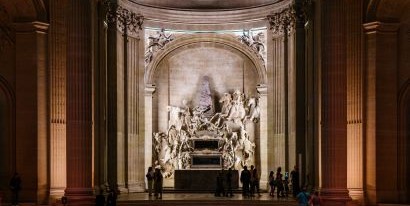
One of the most renowned Marshals of France during the reigns of Kings Louis XIII and Louis XIV, Turenne led the French army to victory in the Battle of Turckheim in Alsace on January 5, 1675. A celebrated figure and a master of military strategy, he was regarded by Napoleon as the greatest military commander of modern times. As a gesture of his admiration, Napoleon had Turenne’s remains transferred to Les Invalides on September 22, 1800, making it the first tomb within the Dome.
The equestrian statues projected onto the wall in this scene are derived from the bronze bas-relief on Turenne’s tomb, which commemorate his military triumph at the Battle of Turckheim.
The Chapelle of the Saint-Grégoire Hubert Lyautey’s tomb
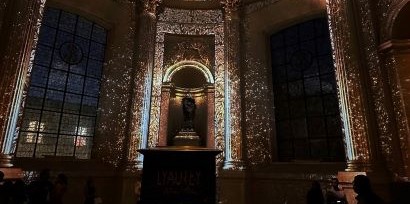
Hubert Lyautey’s tomb is adorned with olive branches, a symbol of peace and reconciliation in Mediterranean culture. The motif served as the inspiration for the wall projections in this scene.
The tomb also bears a famous statement by Lyautey, inscribed in both French and Arabic. Paying tribute to his years as the French Resident-General in Morocco, he said, “The more I know the Moroccans and the longer I live in this country, the more convinced I am of the greatness of this nation.”.
The chapel also houses the urn containing the heart of the French soldier Theophile Malo de la Tour d’Auvergne, to whom Napoleon bestowed the title of the Republic’s first grenadier in 1800.
The Chapelle of Saint-Ambroise Ferdinand Foch’s tomb
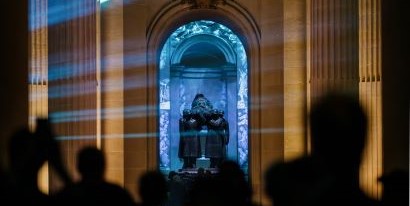
In the final year of World War I, Ferdinand Foch was appointed commander-in-chief of the Allied Forces and was subsequently promoted to the rank of Marshal of France. His final resting place has been beneath the Dome of Les Invalides, within the Chapel of Saint-Ambroise, since 1937.
Foch’s tomb is the work of Paul Landowski, who detailed in his journal his vision for honoring the World War I hero and his soldiers. “All the people bearing death. That’s the top of the monument,” he wrote. These are the individuals whose silhouettes are projected onto the chapel walls in this scene.
The Chapelle of Saint-Thérèse Vauban’s tomb
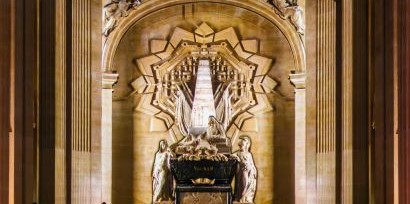
A civil engineer and Marshal of France, Vauban was the architect behind the military fortifications that delineated the kingdom of Louis XIV. Today, 12 of these fortifications are classified as UNESCO World Heritage Sites. The citadels are constructed in a five-pointed star pattern, with an alternating arrangement of bastions and curtain walls designed to withstand sieges and cannon fire. This scene reproduces the star-shaped design.
Napoleon Bonaparte had a funerary monument built to hold the urn containing Vauban’s heart. However, in 1847, it was replaced with a tomb of the same design as Turenne’s to maintain harmony within the space.
The Chapelle of Saint-Augustin Between stone and marble
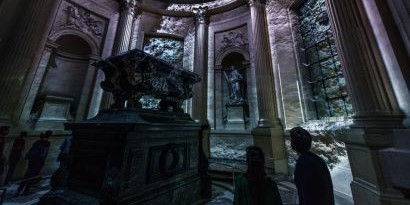
In 1670, the white stone featured prominently in the Dome of Les Invalides was the preferred material of Louis XIV’s architect, Jules Hardouin-Mansart. A century later, Grand Antique marble from the French Pyrenees gained popularity and was used in Joseph Bonaparte’s tomb and Visconti’s high altar. The contrast of these two materials in this scene conveys the transformation of Les Invalides from the Sun King’s reign to its role as the Emperor’s military pantheon.
Joseph Bonaparte’s tomb, found at the center of the chapel since 1864, is crafted from Grand Antique marble. Napoleon’s eldest brother, Joseph ascended to the throne as the King of Naples in 1806 and subsequently as the King of Spain in 1808. His defeat at Vitoria in 1813 marked the end of Napoleonic power in the Spanish Kingdom.
The High Altar Visconti’s great canopy
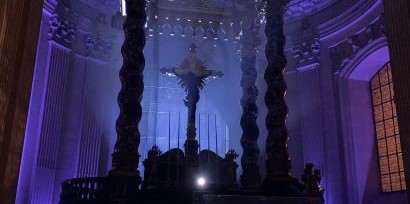
Jules Hardouin-Mansart’s original altar canopy, supported by six spiral columns, was destroyed in 1793 during the French Revolution.
When the Dome church was renovated in 1842 to accommodate Napoleon’s tomb, Visconti took the opportunity to design a new canopy, with four spiral columns made of Grand Antique marble—a highly popular material in Antiquity, and in the 17th and 19th centuries.